
As Muslim parents, we want our children to grow up with the Quran at the center of their lives. But in a world of competing distractions, demanding school schedules, and communities where Muslim children are often a minority, actually giving them that connection requires deliberate effort and the right educational approach. This post makes the case — practically and spiritually — for why every Muslim child should learn Quran classes for kids online.
The Quran’s Own Words on Teaching Children
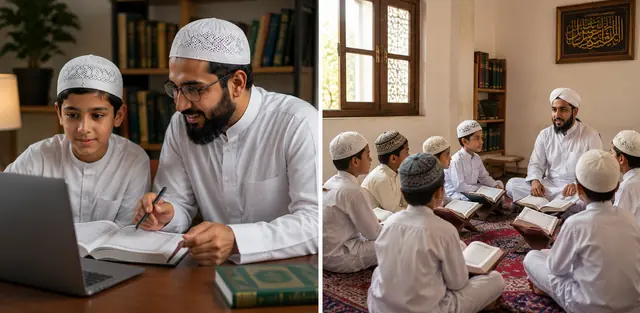
The Prophet Muhammad (peace be upon him) said: “Teach the Quran to your children, for it is the best of education.” This is not a suggestion for families who have extra time — it’s a directive that Islamic scholars across centuries have understood as a foundational parental responsibility.
The Quran itself is full of instructions to parents about raising children with knowledge of Allah and the Quran. Luqman’s advice to his son, recorded in Surah Luqman, covers gratitude to Allah, avoiding shirk, respect for parents, knowledge of accountability, and treatment of others — a complete educational framework that the Quran presents as the model for parental instruction.
Reason 1: The Memorization Window Doesn’t Stay Open Forever
Children between ages five and twelve have a memorization capacity that genuinely diminishes as they move through adolescence and into adulthood. This is not motivational language — it’s neuroscience. The brain’s neuroplasticity for phonological learning (the kind of learning involved in Quran recitation and memorization) is highest in early childhood.
A child who begins Quran learning at age five and studies consistently has a fundamentally different outcome by age fifteen than one who starts at thirteen. The sounds, the patterns, the habits of correct recitation — and Quran memorization — embed themselves differently in a child’s brain than they do in a teenager’s.
Every year a Muslim child spends without Quran education is a year of the highest-capacity learning window passing. This isn’t about pressure — it’s about understanding what’s actually at stake.
Reason 2: Correct Pronunciation Can Only Be Learned Once Easily
Arabic pronunciation — especially the sounds that exist in the Quran but not in English — is learned most naturally in early childhood. Children absorb new sounds automatically in ways that adults cannot. A child who learns the Arabic letters correctly at age five — starting with Noorani Qaida — will have those sounds in their phonological inventory for life. An adult learning from scratch has to consciously work to produce sounds that feel entirely foreign.
More practically: a child who learns incorrect pronunciation early and practices it for years is building habits that require significant effort to change. Getting pronunciation right from the beginning — with a qualified teacher who corrects errors in real time — is the gift that keeps giving for the child’s entire life of recitation.
Reason 3: The Quran as Identity Anchor

Muslim children in the West face identity pressures that are genuinely significant. As they move through school, social media, friendships with non-Muslim peers, and adolescence, the question “who am I?” becomes complicated. Children who have the Quran in their lives — who can recite it, who understand what it says, who feel connected to it — have an anchor that many Muslim children without Quran education lack.
Research on identity development in religious minorities consistently shows that children with strong religious identity tend to navigate adolescence and early adulthood more securely than those without it. Quran education is one of the most direct ways to build that Islamic identity in a child who will grow up as a minority.
Reason 4: Daily Salah Requires Quran Knowledge
Every Muslim prays five times a day. Every unit of prayer requires recitation of Al-Fatiha and at least one additional surah. Salah performed with incorrect pronunciation — letters articulated from the wrong place, Tajweed rules violated, meaning potentially altered — is a salah that scholars discuss in terms of validity.
A child who learns to recite Al-Fatiha and the short surahs correctly, with proper Tajweed, is building the foundation of a lifetime of valid, beautiful salah. This is not abstract — every prayer your child prays for the rest of their life is affected by the quality of Quran education they receive as a child.
Reason 5: Online Quran Classes Make This Accessible for Every Family
Twenty years ago, “teach your child the Quran” meant relying on whatever local teacher or madrassa existed in your city — which in many parts of the West meant poor options, inconvenient times, and unverified teaching quality. Today, online Quran classes for kids mean that any family with internet access can give their child one-on-one instruction from a qualified, vetted teacher.
There are no more geographical excuses. There are no more “we don’t have a good local teacher” barriers. Whatever your location — from the largest Muslim community in North America to the most isolated rural town — qualified Quran teachers are available for your child through online platforms.
At Quran Mentors, our Quran classes for kids are live, one-on-one, with qualified teachers who specialize in working with children. Classes are available across all timezones, seven days a week, with both male and female Quran teachers available. We offer a free trial class so you can experience the format and assess the teacher fit before any commitment.
Reason 6: The Blessings Are Specifically for Children
The Prophet (peace be upon him) said: “Whoever recites the Quran and acts upon it, his parents will be crowned with a light on the Day of Resurrection, the like of which they have never seen in this world.” The blessings of a child who learns and lives the Quran extend to the parents who made that education possible.
This is not a small thing. The effort you put into your child’s Quran education — finding the right teacher, maintaining consistency, supporting their practice at home — is not just an educational investment. It is a spiritual act with stated rewards that Muslim parents should not underestimate.
Ready to give your child the best start in Quran education? Book a free trial class at Quran Mentors — one-on-one, with a qualified teacher, at a time that works for your family.
Frequently Asked Questions
Q: At what age should my child start Quran classes online?
Four to five years old is the ideal starting age for most children. At this age, the neurological window for language learning is at its peak, and children are beginning to have enough attention span for structured short sessions of 20–25 minutes. Starting at age four means your child could be reading the Quran independently by age six or seven — and begins the memorization journey at the age of highest capacity. That said, starting at any age is beneficial — waiting until the “perfect” time means losing time that is genuinely valuable.
Q: How do I keep my child motivated to learn Quran over the long term?
The most powerful motivation tool is your own engagement. When children see that their parents value Quran learning — that you ask about what was taught, that you’re proud of their progress, that Quran is treated as important in your home — they internalize that value. External motivation (reward charts, prizes) works for young children but should transition over time to intrinsic motivation rooted in the child’s own relationship with the Quran. A teacher who connects with your child personally is also a powerful motivator — many children look forward to class specifically because of their relationship with their teacher.
Q: What is the difference between online Quran classes and Quran apps for children?
Quran apps provide content — letters, sounds, recitation recordings — but they cannot hear your child. Tajweed learning and correct pronunciation require a teacher to listen to your child recite and provide specific, real-time correction. Apps are useful supplementary tools but cannot replace live instruction for developing correct recitation. Children who use only apps develop pronunciation habits — some correct, some not — without any mechanism for identifying and fixing the errors. A live teacher catches every error and corrects it before it becomes a habit.
Q: My child is already 12 and has had very little Quran education. Is it too late to start online classes?
Absolutely not. Twelve is still an age of significant learning capacity, and children who begin at this age with consistent instruction make rapid progress — often faster than younger children because their focus and comprehension are more developed. Teenagers who begin Quran education with genuine personal motivation often make the fastest progress of all. The foundation-building phase (Noorani Qaida, basic recitation) is compressed for older children who can handle more per session. Starting at twelve with four sessions per week, a child can be reading the Quran independently within three to four months and can make years of Tajweed and knowledge progress through high school.
Q: How do I choose between different online Quran platforms for my child?
Focus on three things: teacher qualification (ask specifically about Tajweed certification or Ijazah), format (one-on-one live sessions, not group or recorded), and a free trial class before any payment. The trial class is your most important evaluation tool — it shows you actual teaching quality, teaching style, and your child’s response to the teacher. Secondary factors include flexibility of scheduling, availability of female teachers if preferred, and whether parent progress reports are provided.