
Starting your child on Quranic education is one of the most meaningful decisions you’ll make as a Muslim parent. But the right approach — and the right expectations — depend heavily on your child’s age. A five-year-old needs something completely different from a twelve-year-old. This age-by-age guide helps you understand exactly what online Quran classes for kids look like at each stage, what your child can realistically achieve, and how to set them up for success.
Why Start Quran Education Early?
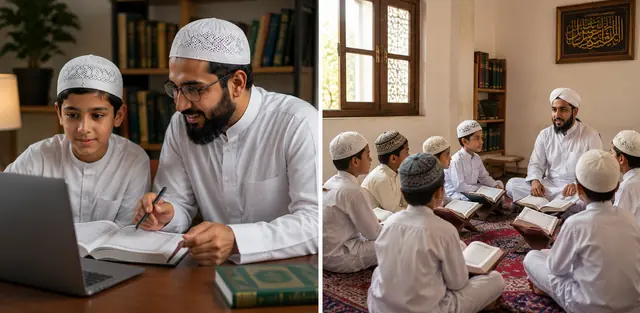
The Prophet Muhammad (peace be upon him) said: “The best among you are those who learn the Quran and teach it.” Starting Quran education during childhood offers advantages that adults simply cannot replicate. Young children’s minds are wired for language acquisition — they absorb pronunciation patterns, memorize with remarkable speed, and build habits that stay with them for life.
Starting early also means more time. A child who begins at age five and studies consistently through their teens will have read through the Quran multiple times, memorized significant portions, and built a relationship with the Book of Allah that will sustain them through adolescence and adulthood. Every year earlier matters.
Ages 3–5: Foundation Stage
Can a three-year-old really learn Quran? The answer is: not the Quran itself, but the foundation. Children at this age can learn to love the Quran — hearing its sounds, recognizing that it’s special, learning very short duas and the Basmala. Some four-year-olds with good focus can begin the first few letters of the Arabic alphabet through play-based instruction.
At Quran Mentors, we offer classes for children as young as four, with both male and female Quran teachers available depending on your family’s preference. Sessions at this age are 20–25 minutes maximum, highly interactive, and game-based. The teacher introduces two to three letters per session through visual flashcards, simple repetition, and songs. Parents often sit in during these sessions, which also helps with practice at home.
What to expect: By age five, many children who’ve started at four can recognize most or all Arabic letters and can recite Surah Al-Fatiha and several short surahs from Juz Amma.
Ages 6–8: Building Reading Skills
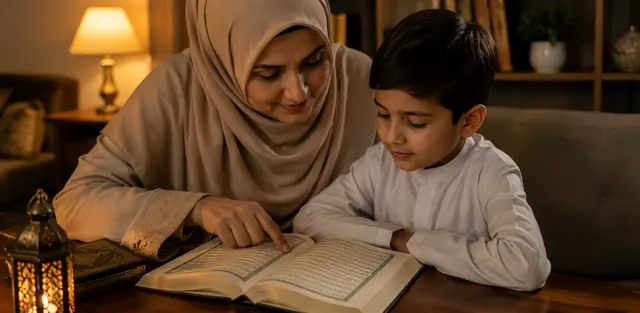
This is the primary Noorani Qaida stage. Children aged six to eight have the focus needed for structured learning and the memory absorption of early childhood. They can sit for 30–40 minute sessions, handle systematic instruction, and retain what they’ve learned between sessions if they practice daily.
At this age, the typical path is: complete the Noorani Qaida (usually four to six months for a six-year-old studying four to five times per week), then move into reading the Quran starting from Juz Amma. The teacher focuses on correct pronunciation of each letter, the vowel marks, and basic Tajweed rules.
What to expect: By age eight, a child who started at six with consistent study can typically read the Quran independently — not fast, but correctly — and has memorized a meaningful portion of Juz Amma.
Ages 9–11: Quran Reading with Tajweed
By this age, children who’ve been studying consistently are ready to focus on quality. They can handle the full rules of Tajweed — the precise rules governing Quranic recitation. Teachers at this level work through the Quran systematically, applying Tajweed rules to every word and correcting errors in real time.
This is also an excellent age to begin Hifz (memorization) if a child shows interest. Children at this age can memorize far more quickly than adults, and with proper revision methods, retain what they’ve learned reliably.
At Quran Mentors, online Quran classes for kids at this age run 40–45 minutes per session, typically four to five times per week for serious Tajweed or Hifz work, three times per week for general reading improvement.
Ages 12–14: Deepening and Advancing
Pre-teens can engage with more sophisticated Tajweed concepts, begin memorizing larger portions of the Quran, and start asking real questions about meaning. This is an excellent age to combine Quran recitation with Tafseer — understanding what the words mean — or with Islamic Studies.
The motivational challenge at this age is real. Pre-teens have competing interests and social pressures. The one-on-one teacher relationship is especially valuable here — a teacher who knows your child personally, who has built rapport over months or years of classes, can provide the consistent encouragement that keeps a twelve-year-old engaged when motivation dips.
Ages 15–18: Consolidation and Achievement
Teenagers who’ve been studying through childhood are typically at an advanced level — fluent recitation, significant memorization, perhaps approaching completion of Hifz. At this age, the focus shifts to consolidation and achievement.
Teenagers who are new to Quran study can also begin at this age — the learning curve is steeper but the motivation (often self-driven at this age) can make up for the lost years. Adult-oriented teaching approaches work well with older teenagers.
How to Support Your Child’s Quran Learning at Home
The teacher provides instruction and accountability. You provide the environment and daily practice. Both are essential. Create a specific time each day for Quran practice — even 15 minutes is enough for young children. Sit with younger children during practice. Make Quran learning feel like a normal, valued part of family life rather than a chore to be checked off.
Ready to start learning Quran? Book your free trial class at Quran Mentors — one-on-one, with a qualified teacher, at a time that works for you.
Frequently Asked Questions
Q: What is the best age to start online Quran classes for kids?
Four to five years old is generally considered the ideal starting age for Quran education. At this age, children are in a prime language acquisition window, their pronunciation instincts are flexible, and they have enough attention span for short structured sessions. Children who start at four or five typically develop strong Quranic reading foundations by age seven or eight. That said, starting at any age is better than waiting — a child who begins at eight will still benefit enormously from proper instruction.
Q: How long should online Quran sessions be for young children?
Session length should match the child’s age and attention span. For children aged four to five, sessions of 20–25 minutes are ideal. Ages six to eight can handle 30–40 minutes. Ages nine and above can typically sustain 45–60 minute sessions. Quran Mentors teachers are experienced in keeping young children engaged through varied activities within these session lengths — alternating between reading practice, letter exercises, and brief recitation to maintain focus.
Q: How many days per week should my child have online Quran classes?
Four to five days per week is ideal for meaningful progress. This frequency allows new material to be taught regularly while giving time to practice and consolidate between sessions. Three days per week is the minimum for consistent advancement. Fewer than three days per week significantly slows progress because children at this age don’t retain new material as effectively with long gaps between sessions.
Q: My child has struggled with attention in weekend madrassa. Will online classes be different?
Yes, frequently. The one-on-one format of online classes eliminates the distractions of a group environment, and the teacher can immediately re-engage a distracted child with a change of activity or pace. Many children who struggle in group settings thrive in one-on-one instruction because the lesson is always about them — there’s no waiting for others, no falling behind, and no boredom from material that’s too easy. That said, finding the right teacher whose energy and style matches your child’s personality is also important, which is why we offer a free trial class.
Q: What if my child doesn’t speak Arabic at home?
This is the situation for the vast majority of our students. Quran classes at Quran Mentors are conducted in English (or Urdu if preferred), and children do not need to speak or understand Arabic to learn to read the Quran. Reading Quranic Arabic is a distinct skill from speaking conversational Arabic — the Quran uses a fully vowelized script, which actually makes it easier to read for beginners than modern Arabic text. Your child will be learning to read and recite correctly; meaning and translation are covered separately in Islamic Studies or Tafseer courses. Start with a free trial class today.