
Tajweed — the precise science of Quranic recitation — is what separates a correct, beautiful recitation from one that’s technically readable but missing the soul of the Quran. If you want to learn Tajweed online, this guide gives you everything you need: what the rules are, how online learning works for Tajweed, a realistic timeline, and practical tips for making progress you can actually hear in your recitation.
What Is Tajweed and Why Does It Matter?
Tajweed is the set of rules that govern the correct pronunciation of the Quran — covering where each Arabic letter is articulated, how it interacts with surrounding letters, and how long each sound should be held. In short: Tajweed is what makes recitation of the Quran correct, not just readable.

The word Tajweed comes from the Arabic root meaning “to make better” or “to improve.” In the context of the Quran, Tajweed refers to the set of rules that govern how each letter, syllable, and word should be pronounced during recitation. These rules were established to preserve the exact way the Quran was recited by the Prophet Muhammad (peace be upon him) — a tradition that has been transmitted through thousands of teachers across fourteen centuries.
Tajweed matters for two reasons. First, it’s a religious obligation — Allah says in the Quran: “And recite the Quran with measured recitation” (Al-Muzzammil 73:4). Second, it has a practical dimension: in Quranic Arabic, precise pronunciation can affect meaning. The wrong pronunciation of a letter can change the meaning of a word, which is why scholars have always treated correct Tajweed as a serious matter.
Can You Really Learn Tajweed Online?
Many people wonder if Tajweed — which is fundamentally about sound — can be taught effectively through a screen. The answer is yes, provided the class is live and one-on-one. Here’s why: the most important element of Tajweed instruction is the teacher hearing the student recite in real time and correcting errors immediately. This is entirely possible via a live video call with clear audio.
What doesn’t work for Tajweed is pre-recorded lessons. Watching videos of Tajweed rules being explained gives you theoretical knowledge, but theory without correction of your actual pronunciation produces limited improvement. The teacher must hear you to teach you.
At Quran Mentors, online Tajweed courses are conducted live, one-on-one, via video call with teachers who are themselves certified in Tajweed through recognized scholarly chains. The teacher listens to every ayah you recite and provides immediate, specific feedback.
The Major Tajweed Rules You Will Learn
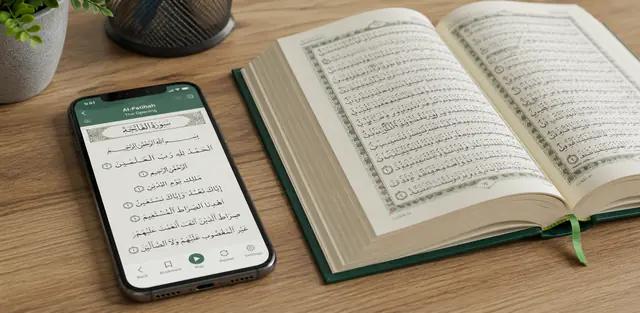
A complete Tajweed course covers a well-defined set of rules. Here are the major categories:
Makharij Al-Huruf (Points of Articulation)
Every Arabic letter is produced from a specific point in the mouth or throat. Learning exactly where each letter originates is the foundation of correct pronunciation. This is where most non-native Arabic speakers have the most room for improvement.
Sifat Al-Huruf (Characteristics of Letters)
Each Arabic letter carries specific characteristics — heavy or light, flowing or stopped, nasal or not. These characteristics interact with context to determine how a letter sounds in a given word.
Noon Sakinah and Tanween Rules
When the letter Noon appears without a vowel, or when tanween (double vowel marks) appears at the end of a word, specific rules determine how these sounds are treated. The four rules — Izhar, Idgham, Iqlab, and Ikhfa — cover the vast majority of situations students encounter in daily recitation.
Meem Sakinah Rules
Similar rules apply to the Meem when it appears without a vowel, covering Ikhfa Shafawi, Idgham Shafawi, and Izhar Shafawi.
Madd Rules (Extended Vowels)
The Madd rules govern how long various vowel sounds should be held during recitation. There are multiple types of Madd, each with a specific duration measured in “counts” (harakat). Getting the Madd rules right has a significant impact on the musicality and correctness of recitation.
Tafkheem and Tarqeeq (Heavy and Light Letters)
Certain Arabic letters are inherently heavy (pronounced with the back of the tongue raised) and others are light. The letter Ra and the letter Lam have both heavy and light pronunciations depending on context. Getting these right is what gives Arabic recitation its distinctive resonance.
Rules of Waqf (Stopping)
Where and how to stop during recitation — which stops are obligatory, which are preferred, and which should be avoided — is an important but often overlooked area of Tajweed.
A Realistic Timeline for Learning Tajweed Online
For a student who can already read the Quran and is studying two to three times per week with a qualified teacher:
1–3 months: Foundational rules covered — Makharij, basic Sifat, Noon Sakinah and Tanween. Immediate improvement in recitation quality noticeable.
3–6 months: Madd rules, Meem Sakinah, heavy and light letters. Recitation starts to sound notably different — more correct and more beautiful.
6–12 months: All major rules covered and applied across reading through the Quran. At one year, most diligent students have a strong practical command of Tajweed and can read the Quran with most rules applied correctly.
12–24 months: Refinement and deeper application. Reading through the complete Quran with careful Tajweed applied to every word. Many students pursue Ijazah after this stage.
For a deeper breakdown of these timeframes by starting level, read our guide on how long it takes to learn Tajweed.
How to Practice Tajweed Between Classes
Practice between sessions is where Tajweed rules become habitual. After each class, read aloud the portion covered for 15–20 minutes, paying attention to the specific rules the teacher corrected. Listen to a certified reciter (such as Sheikh Mishary Rashid Al-Afasy or Sheikh Abdul Rahman Al-Sudais) while following along in the Quran — this trains your ear to what correct recitation should sound like.
Record yourself reciting and listen back. Most students are surprised by what they hear — errors that went unnoticed while reciting are often obvious on playback.
Ready to start learning Quran? Book your free trial class at Quran Mentors — one-on-one, with a qualified teacher, at a time that works for you.
Frequently Asked Questions
Q: Do I need to know Arabic to learn Tajweed?
You don’t need to speak or understand Arabic to learn Tajweed — you need to be able to read Arabic letters. Tajweed is about pronunciation of Quranic text, not Arabic language comprehension. Most Tajweed instruction at Quran Mentors is conducted in English, with Arabic terms introduced progressively. Students who can already read the Quran — even slowly and imperfectly — are ready to begin a Tajweed course.
Q: How is online Tajweed different from learning from YouTube?
YouTube Tajweed videos teach theory — they explain rules but they cannot hear your recitation and correct your errors. Tajweed improvement requires someone to listen to you. A live online Tajweed teacher listens to every ayah you recite, identifies specific errors (which may be different from what the YouTube video covers), and corrects them in real time. Students who have watched extensive Tajweed content online but never had a teacher often discover in their first live class that they’ve been making errors they weren’t aware of.
Q: Is there a specific recitation style (Riwayah) I should learn?
Most online Tajweed courses teach the recitation of Hafs an Asim — by far the most widely used recitation style in the Muslim world, used in the Quran printed in Saudi Arabia and familiar to most Muslims globally. Unless you have a specific reason to learn a different recitation (such as Warsh, which is common in North Africa), Hafs an Asim is the appropriate choice for most students.
Q: Can children learn Tajweed online?
Yes. Children who can already read the Quran can begin Tajweed classes online, often as a natural next step after our Noorani Qaida course. The teaching approach for children is more gradual — rules are introduced through practice and repetition rather than theoretical explanation, and sessions are shorter and more activity-based. Children who learn Tajweed correctly early develop pronunciation habits that stay with them for life, making early Tajweed education a very valuable investment.
Q: Will learning Tajweed slow down my Quran reading?
Initially, yes — applying new rules while reading requires conscious attention, which slows pace. This is temporary. As rules become habitual through practice, they are applied automatically without slowing recitation. Most students find that within three to four months, they’re reading at roughly their previous pace but with significantly better pronunciation. After six months, many students find that correct recitation feels more natural than their old habits did. Start your free Tajweed trial class today.