
One of the most common questions from students beginning their Tajweed journey is: how long does it take to learn Tajweed? The honest answer is that it depends — but this guide gives you a realistic picture based on starting level, study frequency, and what “learning Tajweed” actually means.
What Does “Learning Tajweed” Actually Mean?

This question matters because “learning Tajweed” means different things to different people. There’s an important distinction between:
Knowing the rules theoretically: Understanding what Idgham means, being able to identify a Madd letter, knowing when Ikhfa applies. This can be acquired in a few months of structured study.
Applying the rules fluently while reciting: Reading the Quran aloud with all Tajweed rules applied correctly and automatically, without having to stop and think about each rule. This takes significantly longer — and is the real goal.
Most students reach theoretical understanding within three to six months. Fluent, automatic application typically requires one to two years of consistent practice. This isn’t discouraging — it’s the same pattern as any complex skill, from playing piano to speaking a new language. You learn the rules quickly; embodying them takes time. For a full breakdown of what those rules actually are, see our guide on how to learn Tajweed online.
Timeline Based on Starting Level
Complete Beginner (Cannot Read Arabic)
If you cannot yet read Arabic, Tajweed itself is not the first course — Noorani Qaida is. You’ll first spend three to five months learning letter recognition, vowel marks, and basic pronunciation. After completing Noorani Qaida, you’ll be ready to begin Tajweed study properly.
From the beginning of Noorani Qaida to fluent Tajweed recitation: approximately 18 to 30 months of consistent study.
Can Read But Has Never Studied Tajweed
This is the most common situation — students who learned to read the Quran as children but were never formally taught Tajweed rules. These students can typically cover all the major Tajweed rules in four to eight months. Applying them fluently across the entire Quran typically takes an additional six to twelve months of practice reading.
Total for this group: approximately ten to twenty months to reach fluent Tajweed recitation.
Already Reads with Some Tajweed
Students who have some Tajweed knowledge but want to refine and correct their recitation typically take three to six months of targeted work to identify and fix specific errors and fill gaps in their rule knowledge.
What Factors Speed Up or Slow Down Tajweed Progress?
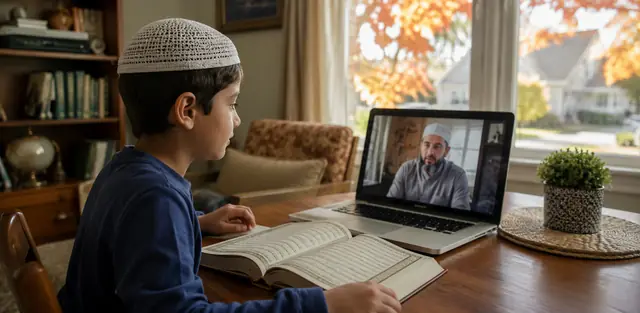
Frequency of Classes
The single biggest factor. A student attending Tajweed classes five times per week progresses roughly twice as fast as one attending three times per week — not just because of more instruction time, but because more frequent sessions mean less forgetting between lessons.
Quality of Daily Practice
15–30 minutes of focused daily reading between sessions, with conscious attention to applying the rules taught in the last class, is what converts instruction into lasting change. Students who attend class but don’t practice between sessions progress significantly more slowly.
Teacher Qualification
A teacher who can precisely identify your errors and explain the correction clearly accelerates progress dramatically. Vague feedback (“your pronunciation here is wrong — try again”) is far less helpful than specific feedback (“your letter Ra here should be heavy because the fatha before it is not separated by a sukoon — try it like this…”). At Quran Mentors, our Tajweed teachers are trained in giving precise, actionable feedback.
Starting Pronunciation Habits
Students who grew up in households where Arabic was spoken or the Quran was recited frequently have an advantage — their ears are already calibrated to correct sounds. Students with no prior Arabic exposure need to develop this calibration from scratch, which adds time.
The Six-Month Milestone
For students who study three to four times per week and practice daily, six months is typically when a meaningful transformation becomes audible. At this point, all the major rules have been covered, many have become habitual, and the student’s recitation is noticeably different from when they started — more deliberate, more correct, and in many ways more beautiful.
This six-month mark is also where many students feel a significant increase in motivation. Early Tajweed learning can feel technical and slow. By the six-month mark, the recitation sounds genuinely better, and that audible improvement is deeply satisfying.
After the Rules — The Path to Mastery
After completing the formal Tajweed curriculum (covering all rules), students move into what’s sometimes called “applied Tajweed” — reading through the complete Quran with careful Tajweed applied to every word. This phase, which may take one to two years, is where the rules become truly automatic.
Students who complete this phase and want formal certification of their Tajweed proficiency can pursue an Ijazah — a formal scholarly certification that they can recite the Quran with correct Tajweed through a verified chain of transmission.
Ready to start learning Quran? Book your free trial class at Quran Mentors — one-on-one, with a qualified teacher, at a time that works for you.
Frequently Asked Questions
Q: Can I learn Tajweed on my own without a teacher?
You can learn Tajweed theory without a teacher — there are books and videos that explain every rule clearly. But you cannot verify your own pronunciation. The human ear naturally adapts to what it hears most — if you’ve been pronouncing letters incorrectly for years, those incorrect sounds feel correct to you. Only a qualified teacher hearing your recitation can identify the specific errors you’re making. Self-study of Tajweed theory is useful supplementary material, but it cannot replace live instruction and correction.
Q: At what age is it easiest to learn Tajweed?
Children between ages five and twelve learn Tajweed most easily because their pronunciation instincts are still flexible — they haven’t yet established firm habits that need to be un-learned. That said, teenagers and adults can also learn Tajweed effectively. The difference is not ability but habit: adults need to actively work to override existing pronunciation patterns, while children simply absorb correct pronunciation from the start. This is why starting Quran education early has such a significant long-term advantage.
Q: How do I know if my Tajweed is improving?
The clearest indicators are: your teacher corrects you less frequently over time, you can recite longer passages without stopping to think about rules, and your recitation sounds more similar to certified reciters you listen to. Recording yourself reciting the same passage every month and listening back is an excellent way to track improvement. Many students are surprised by how much their recitation changes over six to twelve months when they hear early recordings.
Q: Is Tajweed mandatory (fard) for every Muslim?
Islamic scholars distinguish between two obligations: it is fard ain (individually obligatory) for every Muslim to recite Al-Fatiha and basic surahs correctly in salah. It is fard kifaya (communally obligatory) to preserve the full Tajweed tradition — meaning the community as a whole must have people who know the complete Tajweed rules, even if not every individual studies them formally. However, learning Tajweed is universally recommended because it improves the quality of your worship and ensures your recitation is as the Quran was revealed.
Q: Should I learn all 10 Qira’at or just Hafs?
For the vast majority of students, learning one recitation tradition — specifically Hafs an Asim — is the right approach. Hafs is the recitation used in the most widely distributed Qurans globally and is what most Muslims worldwide are familiar with. The other nine recitation traditions are advanced scholarship pursued by students who have already mastered Hafs and want to expand their knowledge. Beginning with any other recitation when Hafs is the standard in your community creates unnecessary complexity. Start with Hafs, master it, then consider others if you have scholarly ambitions. Book your free Tajweed assessment today.