
Technology has transformed how Muslims worldwide access Quran education. Today, a motivated student anywhere in the world can learn from a qualified scholar — without leaving home, without visa requirements, and without fitting into someone else’s schedule. Here are ten specific benefits of learning Quran online that make this format genuinely superior to many alternatives for most students.
1. Access to Qualified Teachers Regardless of Location

This is the most transformative benefit of online Quran learning. Before the internet, a Muslim living in rural America, suburban Canada, or a small UK town was limited to whatever teachers were available locally — which was often no one qualified, or at best, a community volunteer whose credentials were unclear.
Online Quran learning removes geography as a barrier entirely. A student in Montana has access to the same qualified, Ijazah-certified teachers as a student in London’s Muslim-dense East End. A family in rural Australia can work with a specialist Hifz teacher trained in Pakistan. The quality of your Quran education no longer depends on where you happen to live.
2. One-on-One Instruction for Every Student
Online Quran classes through quality platforms are conducted one-on-one — just the student and the teacher. This format is the gold standard for Quran instruction because Tajweed correction requires the teacher to hear every word the student recites. In a group setting, this is impossible to provide to every student in every session. Online one-on-one learning makes the highest-quality instruction format the standard, not the premium exception.
3. Flexible Scheduling That Fits Your Life
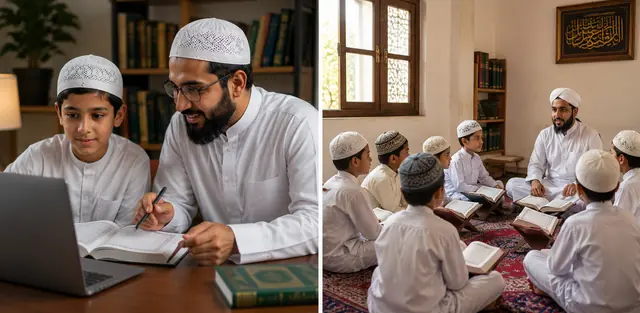
Traditional madrassa has fixed times. Your attendance depends on matching your schedule to theirs. Online Quran classes work the other way around — the teacher’s availability is matched to your preferred time. Morning before work, evening after dinner, weekend afternoons, early Fajr sessions — whatever works for your household is what gets scheduled.
This flexibility is especially valuable for families with irregular work schedules, multiple children with competing activities, or parents who travel. Your classes stay consistent even when your location changes.
4. Consistent Progress with Regular Sessions
Weekly madrassa means six days of non-reinforcement between sessions. Much of what was learned in Saturday class fades by the following Saturday, and teachers spend significant time re-covering ground. Online classes can run three to five times per week — short enough gaps that learning compounds rather than resets. This frequency difference is a primary reason online students consistently progress faster than weekly madrassa students.
5. Comfortable Learning Environment
Learning at home removes several layers of stress from the educational experience — no getting ready and commuting, no unfamiliar social environment, no performance anxiety in front of peers. Students (particularly children who are shy, anxious, or have learning differences) often perform significantly better in the comfort of their home environment than in an institutional setting.
The learning environment also means you can set up the space optimally — good lighting, the right chair height for a young child, a dedicated mushaf within easy reach. These details matter for sustained attention.
6. Female Teachers Accessible for Any Student
Finding a qualified female Quran teacher locally is often difficult or impossible — particularly outside major cities. Online learning gives every family access to a deep pool of qualified female teachers regardless of where they live. Families who need or prefer a female teacher for their daughter (or for the adult women in the family) can have that preference fully accommodated.
7. Continuity Even When Life Changes
Families move. Students study abroad. Parents travel for work. In-person Quran education is disrupted by all of these life changes. Online classes continue uninterrupted through house moves, travel, and relocation — as long as you have internet access, your teacher is there. This continuity matters enormously for long-term projects like Hifz, where interruptions can cause significant regression.
8. Recorded or Parent-Observed Sessions
Many online Quran platforms offer session recording or the option for parents to observe classes easily — simply sitting nearby during the live session. This transparency allows parents to stay informed about what their child is learning, how the teacher works, and whether the teaching style is a good fit. Parents who are present during or aware of session content can reinforce learning between sessions effectively.
9. Easy Access to Specialized Courses
Online learning makes it easy to access specialized courses that may not be available locally — an Ijazah program, an adult Hifz course, Quranic Arabic, advanced Tafseer, or Islamic Studies at a specific level. At Quran Mentors, the full range of Quran education — from Noorani Qaida for beginners through Ijazah for advanced students — is available to every student through the same platform, with teachers qualified for each specialization.
10. Cost-Effective Compared to Local Private Tutors
Local private Quran tutors — if qualified ones can even be found — often charge rates comparable to academic tutoring in major cities, because their supply is limited. Online platforms draw from a global teacher pool and can offer competitive rates because teachers aren’t limited to serving a single local market. The combination of lower cost and better qualified teachers makes online Quran education genuinely superior value for most families.
Ready to start learning Quran from home? At Quran Mentors, every student gets a dedicated one-on-one teacher, flexible scheduling, and a free trial class — no commitment required. Join thousands of students already learning with us.
Frequently Asked Questions
Q: Is learning Quran online as spiritually effective as learning in person?
This is a fair and thoughtful question. Some Muslims feel that learning in a physical Islamic environment carries spiritual benefits that online learning doesn’t fully replicate. This concern is valid for the environmental and community aspects of madrassa education. However, the core of Quran learning — correct recitation transmitted from qualified teacher to student — is not diminished by the online format. The spiritual benefit of learning to recite the Quran correctly comes from the correctness of the recitation, the sincerity of the learner, and the knowledge of the teacher. All of these are present in a quality online session.
Q: My internet connection is unreliable. Can I still learn Quran online?
A stable connection is important for online Quran classes because the teacher needs to hear your pronunciation clearly. If your home internet is unreliable, options include using a mobile data connection (often more stable for live audio), investing in a WiFi booster if your router is far from your learning space, or choosing a data-only device that prioritizes connection stability. In most homes with standard broadband, internet quality is sufficient. If you have persistent connection issues, discuss them with your platform — most teachers are flexible about adjusting to audio-only when video degrades.
Q: How do online Quran classes maintain student motivation over the long term?
Sustained motivation in any long-term educational pursuit requires visible progress, positive relationships, and meaningful milestones. Online one-on-one classes naturally provide all three: progress is clearly visible because the teacher tracks advancement through the curriculum, the teacher-student relationship deepens over consistent weekly interaction, and platforms like Quran Mentors track and celebrate milestones (completing Noorani Qaida, completing Juz Amma, completing the full Quran reading). Many students report that having a real teacher they don’t want to disappoint is more motivating than any app or self-study system.
Q: Are online Quran classes good for children who are very young (under 5)?
Children under four typically don’t have the attention span for structured online learning sessions. For children aged four to five, very short sessions (15–20 minutes maximum) with a teacher experienced in early childhood instruction can be effective and enjoyable. The sessions are activity-based — learning letters through games, listening to short surahs, practicing a few sounds — rather than formal instruction. Many children who start at age four develop a positive relationship with Quran learning that makes their transition to more structured classes at age five or six much smoother.
Q: Do I need special equipment to learn Quran online?
No special equipment is needed beyond what most households already have. A laptop, tablet, or smartphone with a working camera and microphone is sufficient. Headphones or earbuds improve audio quality and reduce echo (making it easier for the teacher to hear your pronunciation). A stable internet connection is important. The mushaf (physical Quran) is used in class alongside the screen. Beyond these basics, no additional investment is needed to begin.