What Does Islamic Studies for Kids Online Actually Cover?
If you’re raising children in the West, you already know the challenge. Between school, homework, sports, and everything else pulling at your child’s schedule, fitting in proper Islamic education can feel almost impossible. Weekend madrassa helps — but two hours on a Saturday morning barely scratches the surface. That’s exactly why so many Muslim parents across the USA, UK, and Canada are turning to Islamic Studies for kids online as a smarter, more consistent alternative.
This guide walks you through everything you need to know — what online Islamic Studies actually covers, how to choose the right program, what age to start, and what your child will genuinely learn when the lessons are structured properly.
What Does Islamic Studies for Kids Online Cover?
Islamic Studies is broader than most parents realize. It’s not just memorizing a few duas or knowing the five pillars. A well-designed program for children covers knowledge that shapes how they think about their faith for the rest of their lives.
At Quran Mentors, our Islamic Studies for kids curriculum is structured around several core areas, adapted to each child’s age and level.
Aqeedah (Islamic Belief)
Children learn about Allah, His attributes, the angels, the prophets, and the purpose of this life. This isn’t rote memorization — teachers explain concepts in age-appropriate language so kids actually understand what they believe and why.
Fiqh (Practical Rulings)
How to make wudu correctly. How to pray. What breaks your fast. These are practical matters every Muslim child needs to know, and learning them properly — rather than picking up bad habits — makes a real difference.
Seerah (Prophet’s Biography)
The life of the Prophet Muhammad (peace be upon him) is one of the most powerful educational tools available to Muslim parents. When children hear his story with context and detail, it builds love for the Prophet and gives them a moral framework for real-life decisions.
Hadith and Islamic Ethics
Selected hadith appropriate for children, covering honesty, kindness, respect for parents, treatment of neighbors, and how to handle conflict. These lessons connect Islamic values to daily life in a way that sticks.
Islamic History
The Caliphs, the great scholars, the civilizations built by Muslims — children who know this history carry a sense of identity and pride that protects them through the identity pressures of growing up as a minority in the West.
Why Islamic Studies for Kids Online Works Better Than You’d Expect
Many parents are initially skeptical. Can a child really learn their deen through a screen? The honest answer is: it depends entirely on how the class is structured.
Group classes — whether online or in a physical madrassa — have an inherent limitation. The teacher cannot give every child the attention they need. A shy child falls behind. A quick learner gets bored. Questions go unasked.
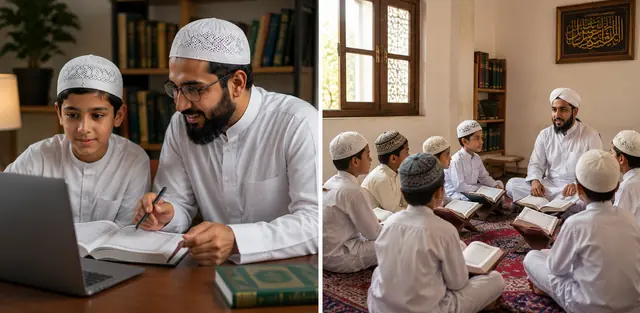
Live, one-on-one Islamic Studies classes are different. The teacher adjusts the pace entirely to your child. If your daughter needs more time understanding the difference between fard and sunnah, the lesson slows down. If your son has already grasped that concept and wants to go deeper into Seerah, the teacher moves forward. No child is left waiting, and no child is left behind.
How Online Islamic Studies Compares to Weekend Madrassa
Weekend madrassas do important work, and many families combine them with online classes rather than replacing one with the other. But it’s worth being honest about the limitations of Saturday school.
Two hours per week, in a group of 15–20 children, with a teacher managing behavior as much as teaching — the actual learning time per child is limited. By the time a child reaches their teens having attended madrassa for years, many still struggle with basic fiqh questions or cannot explain core beliefs clearly.
Online Islamic Studies classes run two to four times per week. Every session is dedicated to your child. Over the course of a year, the difference in coverage — and in retention — is significant.
There’s also the consistency factor. Weekend madrassa is cancelled for Eid, for school trips, for bad weather. Online classes happen from home, on a schedule that works around your family’s life.
What Age Should Children Start Islamic Studies Online?
Children as young as four or five can begin with simple Islamic Studies content — learning basic duas, the names of Allah, short stories from the Seerah told at their level. The classes at this age are short (20–25 minutes) and activity-oriented.
From age six or seven, children can begin more structured learning — the five pillars in detail, how to perform wudu and salah correctly, selected hadith with explanation.
By ages nine to twelve, children are ready for Aqeedah in depth, early Islamic history, and fiqh topics that apply to their daily lives — purity, prayer, fasting, halal and haram in food and interaction.
Teenagers benefit from a more discussion-based approach — exploring Islamic ethics in the context of the pressures they actually face: social media, relationships, identity, career choices. This age group especially benefits from having a knowledgeable teacher they can ask real questions without embarrassment.
Combining Islamic Studies with Quran classes
One of the most practical arrangements many Quran Mentors families use is combining Islamic Studies with Quran recitation or Tajweed lessons. Your child might have Quran class three days a week and Islamic Studies twice a week — all through the same platform, often with the same teacher who already knows your child’s learning style.
This combination is especially powerful because Islamic Studies gives children the context behind what they’re reciting. Understanding who Allah is, why we worship Him, and what the Prophet taught makes the Quran more meaningful rather than just a set of sounds to learn to pronounce — many families pair it with our Noorani Qaida or Tajweed classes.
How to Get the Most from Online Islamic Studies as a Parent
Your involvement makes a real difference, even if you’re not in the room during class.
Ask your child after each class what they learned today. Even a five-minute conversation reinforces the lesson and signals to your child that what they’re learning matters to you. If your child knows you’ll ask, they pay more attention.
Revisit what they’ve learned in daily life. If the lesson was about honesty, mention it when an opportunity arises during the week. If they learned about Seerah, watch a short documentary together or read a story from the Prophet’s life at bedtime.
Coordinate with the teacher. Good Islamic Studies teachers welcome parent input. Let them know what your child is curious about, what values you want reinforced, or what questions your child has been asking at home.
What to Look for in an Online Islamic Studies Program
Not all online Islamic Studies programs are equal. When evaluating a program for your child, look for teachers with formal Islamic education credentials, a structured curriculum with clear learning outcomes at each level, one-on-one format or very small groups, regular progress updates to parents, male and female teacher options, and a free trial so you can assess the teacher before committing.
Quran Mentors has served students in over 130 countries since 2018. All teachers hold recognized Islamic education credentials and are vetted through a rigorous hiring process. We offer both male and female teachers, and parents can request a specific teacher based on their child’s needs and comfort level.
Frequently Asked Questions
Q: What age can children start Islamic Studies online?
Children can begin as early as age four with simplified, story-based Islamic Studies content. At this age, sessions are short and activity-driven. From age six onward, children can handle more structured learning covering duas, salah, and basic aqeedah. The curriculum is always tailored to match the child’s age and ability level.
Q: Do kids need to know Arabic for Islamic Studies?
No. Islamic Studies for kids is taught in English (or Urdu if preferred), so your child does not need any Arabic knowledge to begin. Where Arabic terms are introduced — such as the names of Allah’s attributes or fiqh terminology — the teacher explains them clearly in simple language. Arabic literacy is a separate course that can run alongside Islamic Studies if you choose.
Q: Can Islamic Studies be combined with Quran classes?
Absolutely, and many Quran Mentors families do exactly this. Children can have Quran recitation or Tajweed classes on some days and Islamic Studies on others. Combining both courses deepens your child’s understanding — the Quran becomes more meaningful when paired with knowledge of Islamic belief, history, and practice.
Q: Is there a female Islamic Studies teacher available?
Yes. Quran Mentors has qualified female Islamic Studies teachers available for both girls and boys. Many parents — especially for daughters who have reached or are approaching adolescence — specifically request a female teacher, and we accommodate that fully. Female teachers can cover all areas of the Islamic Studies curriculum including Aqeedah, Fiqh, Seerah, and Hadith.
Q: How is online Islamic Studies better than weekend madrassa?
Weekend madrassa typically offers two hours per week in a group setting. Online Islamic Studies at Quran Mentors provides live, one-on-one sessions two to four times per week — meaning your child receives far more individual instruction time over the course of a year. The teacher knows your child personally, adjusts the pace to their level, and can answer questions in real time. Many families use both — madrassa for community and online classes for deeper, consistent learning. Start your free trial today with no credit card required.